

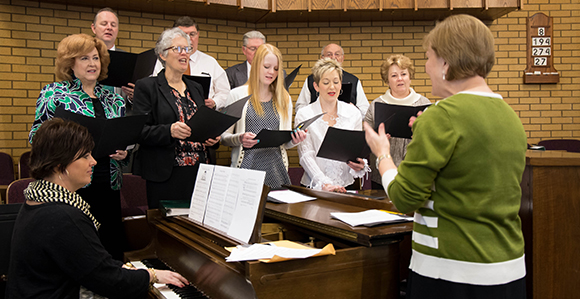
I just passed the baton, after several years as church choir accompanist (this photo is random, not from my local congregation!). To help myself remember and have a head start next time it’s my turn, I wrote down some things I’ve learned and thought I’d share them here.
- Look through new music, checking for changes in tempo, key, time signature, etc., and for challenging passages and difficult page turns.
- Copy the music right away, and lay it out however works best for you. (To respect copyright, destroy the copies after the performance.) Turning small, thin paper pages is a pain at best, and at worst they can go flying off the piano. I like to use a binder with sheet protectors. (Some accompanists tape the copied pages to file folders or to each other, but I find this unwieldy and not very portable.) I like having everything in one place, and for events like Christmas I can organize the music in performance order.
- Ask the conductor about the tempo right away, so you’re practicing about the same as they’ve got in mind.
- Practice both the parts and the accompaniment. Be precise, because the choir relies on you. Notice rhythm details, articulation, and spots where they’ll need extra help. When possible, be ready to play all four parts together. When the parts are on four separate lines, (no one expects you to read that!), and the accompaniment offers little help with parts, plan how you can play a full chord or two in every measure to help the choir stay in tune (and still practice individual parts too).
- Practice every day. Assume (unless otherwise informed) that any song the conductor has given you will be fair game at any rehearsal, both parts and accompaniment. Because your attention will be split between the conductor, the choir, and the music itself, you’ll need to know it better than you would for a solo performance.
- Recognize and prepare for passages you know you’ll never quite master. Choose what to leave out. Focus on maintaining the rhythm and feel of the song.
- Plan and practice page turns. Plan when to turn, whether you’ll need to leave out any notes, which hand will turn, and memorize the first bit of the upcoming page.
- Practice key changes.
- Plan to slow down a tiny bit at the end of any piano intro or interlude. This is an important trigger/clue for the choir.
- Listen to the choir and make sure you’re balancing with them. If you can’t hear the choir clearly, you’re too loud. But if you’re too quiet, they won’t sing as confidently. This can change within a song. For example, maybe the women are singing alone at one point, and they’re a little timid, so you’ll have to be careful not to drown them out.
- Watch the conductor. Just like a soloist has the prerogative to slow down or speed up at will, so does the conductor. Same with dynamics. The accompanist is an indispensable support, because the choir will follow you as much as they follow the conductor. Your job is vital to helping the conductor fulfill their vision for the piece.
- Practice and play as artistically as any performance. Though the conductor makes the musical choices, you can implement them fully. The choir will follow your lead, plus your part adds a lot to the complete musical package.
 Just Create!